












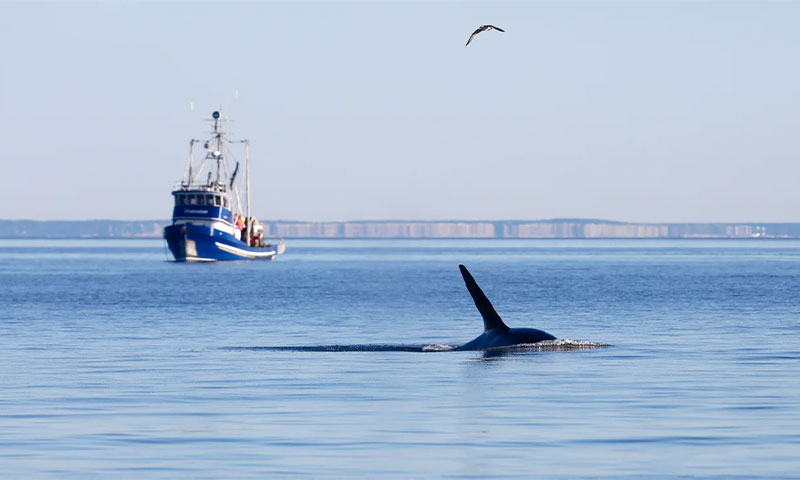
سمندری جہازوں کے شور اور ٹکراؤ سے خطرے میں گھری نایاب وہیلز کے تحفظ کے لیے مصنوعی ذہانت (اے آئی) سے لیس جدید نظام متعارف کرا دیا گیا۔ امریکی ریاست واشنگٹن کے ساحلی علاقے میں نصب ایک خصوصی سمندری بوائے زیرِ آب آوازوں کی مدد سے وہیلز کی موجودگی کا پتا لگائے گا۔
امریکی نشریاتی ادارے سی این این کے مطابق اس منصوبے کا مقصد جنوبی رہائشی کلر وہیلز (Southern Resident Killer Whales) کی نقل و حرکت کا سراغ لگانا اور جہازوں کو ان کی موجودگی سے بروقت آگاہ کرکے ممکنہ تصادم سے بچانا ہے۔ یہ وہیلز کی ایک نایاب اور معدومی کے خطرے سے دوچار آبادی ہے، جس کے صرف 76 ارکان باقی رہ گئے ہیں۔
مزید پڑھیں:کیلیفورنیا کے ساحلوں پر نیلی وہیلز کی خاموشی، نئی تحقیق نے خطرے کی گھنٹی بجادی
یہ وہیلز موسم گرما کے اختتام سے سردیوں کے آغاز تک امریکی شمال مغربی ساحلی علاقے کے سالش سمندر (Salish Sea) اور پجٹ ساؤنڈ(Puget Sound) کا رخ کرتی ہیں، جہاں ان کی بنیادی خوراک چنوک سالمن مچھلی ہے۔ سمندری جہازوں کا شور ان کی خوراک تلاش کرنے، ایک دوسرے سے رابطے اور آواز کی لہروں سے راستے اور شکار کا تعین کرنے کی صلاحیت متاثر کرتا ہے، جبکہ جہازوں سے ٹکراؤ بھی ان کی زندگی کے لیے بڑا خطرہ ہے۔
سی این این کے مطابق مائیکروسافٹ، کوائٹ ساؤنڈ اور ایس ایم آر یو کنسلٹنگ نے مشترکہ طور پر مصنوعی ذہانت سے چلنے والا صوتی نگرانی کا نظام تیار کیا ہے۔ جولائی میں ہارو آبنائے (Haro Strait) میں نصب کیے گئے اس بوائے میں 3 زیرِ آب مائیکروفونز (ہائیڈروفونز) موجود ہیں، جو وہیلز کی مخصوص آوازیں ریکارڈ کرتے ہیں۔ مصنوعی ذہانت کا نظام ان آوازوں کا تجزیہ کرکے قریباً حقیقی وقت میں ان کی شناخت کرنے کی کوشش کرتا ہے۔
A 30-ton whale surrounded by dozens of sharks is not the one in danger.
The most violent moment in this video is the whale’s own doing.
And it’s the sharks that end up swimming away from the splash.Nobody on the boat believed that at 6:14 a.m., when Dev Anand started shouting.
“Shark attack! Whale! There’s a whale and it’s covered in sharks!”
It was forty miles from the nearest reef, and the sea was the flat, bright blue of a screen waiting for a signal. Nina Voss had been awake since four, checking housings and batteries on her underwater rig, the way she did before every dive, the way her old mentor had drilled into her: boring checks save expensive footage.
Dev was nineteen. He had been hired to carry cases and had somehow become the loudest observer on the boat. He was pointing off the bow with his whole arm.
Everyone moved at once. Bastien, the skipper, killed the engine. Dr. Imani Rask, the cetacean biologist who had chartered the boat for a two-week survey, came up the ladder from the cabin with a coffee in one hand and binoculars in the other. Nina was already lifting the camera.
What they saw looked like the worst kind of nature documentary. A humpback whale, enormous and dark, hung near the surface, and around it, in ragged loops, moved dozens of sharks. Their dorsal fins cut the water like torn paper. The whale’s long white flipper rose and fell in the middle of them.
“They’re eating it alive,” Dev said. His voice cracked. “We have to do something. Call someone.”
“Call who?” Bastien asked, not unkindly. “The shark police?”
Dev didn’t laugh. Nina understood why. She felt the same pull in her own chest, the pull every viewer would feel when they saw this footage later. A big gentle animal. A swarm of predators. A story with an obvious villain and an obvious victim. The brain finishes that story before the eyes have finished looking.
Imani lowered her binoculars. She was a small woman in her fifties with a sunburned nose and the calm of someone who had been wrong in public often enough to stop being afraid of it.
“Nina,” she said. “Can you get in the water?”
“Now?”
“Now. Before it changes. I want that camera under the surface. Everyone else stays on the boat and keeps counting.”
“Counting what?” Dev asked.
“Sharks. Out loud. Don’t tell me what you think is happening. Tell me what you can count.”
That was the first lesson of the morning. It would take Nina a long time to understand how much it was worth.
—
RULE 1: COUNT BEFORE YOU CONCLUDE.
Nina slid off the stern platform with the rig held out in front of her, and the world went quiet in the way it only does under the surface, a hush with a heartbeat in it. Her regulator hissed. The light came down in long slanting blades, and the blue below her had no floor.
She had been a cinematographer for eleven years. She had filmed reef sharks at feeding stations, hammerheads in a school off a seamount, a tiger shark so curious it had mouthed her housing like a puppy. She knew what fear felt like in her body, and she knew it was a poor instrument for measuring anything.
Through the radio clipped to her mask strap, Dev’s voice crackled. “Eleven! I count eleven! No, fourteen!”
“Slow down,” Imani said. “Count the ones you can see all at once. Then count again in ten seconds. Tell me both numbers.”
Nina rolled the camera and let the scene come to her. The sharks were not what she expected. They were slim, graceful, and mostly under three meters long, with the narrow bodies of open-ocean species. She recognized silky sharks, named for the smooth skin that gives them a sheen in the light. A handful were bulkier grey reef sharks. They moved in loose, lazy circles, and not one of them was touching the whale.
“Twenty-two,” Dev reported. “Then twenty-six. Then, uh, nineteen. They keep moving.”
“Right,” Imani said. “That’s the first thing to write down. The number changes. A crowd that looks like fifty at first glance is usually twenty-something on a careful count, and the ones who leave and come back get counted twice. Panic doubles everything.”
Nina kept filming. The sharks were circling, yes, but circling is not biting. She watched a silky shark pass within a body length of the whale’s flipper and veer away without a flicker of interest. She watched another drift beneath the whale’s belly and keep drifting.
There was a thing she had learned from years of editing footage and could never quite explain to the people who watched it: the camera does not lie, but it compresses. A wide lens on twenty animals makes them look like a mob. A longer lens on the same twenty makes them look like a scattering. What you see is partly what you stand next to.
“Report,” Imani said.
“I count nineteen sharks,” Nina said. “None of them are touching the whale. None of them are attacking. They’re just around it.”
“Thank you,” Imani said. “That’s what we know. Everything else is a story.”
Here is what is actually true about sharks and humpbacks, and you can check every word of it. Sharks do feed on whales, but overwhelmingly on dead ones. Tiger sharks and great whites are well documented scavenging whale carcasses, sometimes in numbers. Documented attacks on healthy adult humpbacks are rare. The animal that does hunt humpbacks, mostly their calves, is the orca. A swarm of sharks near a living whale is far more often a crowd drawn by food, leftovers, or simple curiosity than a pack in mid-kill.
RULE 1: Count before you conclude. A first glance gives you a feeling. A careful count gives you a number. Write down what you can actually see, then count again, because the second number is almost always smaller and calmer than the first.
—
RULE 2: DO THE ARITHMETIC OF SCALE.
“Okay,” Dev said on the radio, a little embarrassed now. “So they’re not eating it. But they could.”
“Could they?” Imani asked. “Do the math. Nina, give me a size on the nearest shark.”
Nina ranged the camera against the nearest silky shark. She had a habit of holding her arm out and judging length against her forearm and hand, and she did it now, quickly. “Two and a half meters. Maybe a bit more. Two-seventy.”
“Weight?”
“A big one like that? Two hundred kilos, tops. Probably less.”
“And the whale?”
Nina turned the lens and let it travel along the dark body. She had to tilt the camera to keep it in frame. The whale was as long as a city bus and then some.
“Fifteen meters,” she said. “Sixteen.”
“A humpback that size runs somewhere between twenty-five and forty tons,” Imani said. “Call it thirty. Thirty thousand kilos against two hundred. Dev, you’ve got a phone. What’s thirty thousand divided by two hundred?”
A pause. “One hundred fifty.”
“One hundred fifty to one. Each shark is one hundred fifty times lighter than the whale, and that is the biggest shark in the picture. Now imagine a pack of dogs trying to take down a bus. The dogs aren’t stupid. That’s why they don’t try.”
Nina laughed into her regulator and it came out as bubbles. The image stuck. She had noticed it too, on the video she was recording: the sharks moved around the whale the way pigeons move around a parked truck.
Scale is the most underused tool in telling what’s dangerous and what’s only dramatic. Humpback whales are 14 to 17 meters long as adults. Their pectoral flippers can reach about five meters, around a third of their body length, the longest of any whale. The scientific name, Megaptera novaeangliae, translates roughly as “big-winged New Englander,” and anyone who has seen that flipper cut through the water understands the first half. A single flipper slap is a weapon on a scale sharks cannot match. The animals around the whale know it, in whatever way a shark knows things.
Nina filmed the long white flipper as it swung gently through the water. It was nearly twice as long as the sharks beside it.
RULE 2: Do the arithmetic of scale. When a picture frightens you, put numbers on both sides of it. Fear collapses the size difference. A calculator restores it. If one side outweighs the other by a factor of a hundred, ask what the lighter side would actually have to do to win, and whether you see it doing that.
—
RULE 3: ASK WHAT THE BODY IS DOING, NOT WHO IS NEARBY.
The whale shifted.
Nina felt it before she saw it, a change in the water pressure against her chest, like a door opening somewhere in a large house. The humpback tilted. Its long body rolled in a slow, deliberate arc, and the pale underside came up toward the light.
“Imani,” she said. “It’s turning over.”
“Describe it.”
“The throat. I can see the throat.” She zoomed in without breathing. The underside of the whale was lined with grooves, long parallel folds that ran from the jaw back along the belly. “It’s got pleats. Hundreds of… no. Dozens. It’s opening them.”
“Say that again.”
“The throat is expanding. Like a sail filling.”
On the boat, Imani put her coffee down on the rail. When Nina remembered this moment later, she could hear the exact sound the cup made on the metal.
“That,” Imani said, “is a lunge feed.”
Humpbacks are rorquals, a family of baleen whales with accordion-like pleats along the throat, somewhere between fourteen and thirty-five of them depending on the species. In a lunge, the whale accelerates toward a dense cloud of prey, drops its lower jaw nearly ninety degrees, and takes in thousands of liters of water in a single gulp. The pleats unfold and the throat balloons to many times its resting size. Then the whale closes its mouth and pushes the water out through its baleen plates, which work like a giant comb, and swallows the small fish or krill trapped behind.
In a feeding season, a humpback can eat on the order of a ton and a half of food a day. They do it with no teeth at all.
“Look below the whale,” Imani said. “Is there bait?”
Nina tilted the camera down. She hadn’t been looking at the water beneath the animal because she’d been busy looking at the animals around it. And there it was, a shimmering sphere of tiny silver fish, tight as a fist, pulled together and trembling. A bait ball. The kind of thing that draws every predator in a ten-mile radius.
The sharks were not there to eat the whale. They were there for the same thing the whale was.
“They’re all here for the fish,” Nina said.
“Bingo,” Imani said. “The sharks and the whale were never in the same story. They were in the same neighborhood, at the same restaurant, on the same morning. The whale is the one who happens to be able to eat the entire menu in a single bite.”
RULE 3: Ask what the body is doing, not who is nearby. Proximity is not interaction. Two creatures in the same frame can be pursuing two different goals. Watch the posture, the mouth, the direction of travel, and ask what each one is trying to get. People who skip this step end up with a villain they invented.
—
RULE 4: SAY OUT LOUD WHAT DOESN’T FIT.
“Wait,” Imani said suddenly. “Hold on.”
Nina froze, finger on the shutter. The whale hung beneath her, throat swelling, the bait ball swirling closer. “What?”
“This shouldn’t be happening.”
“What shouldn’t?”
“This is a warm-water, open-ocean site, and it’s a few months into the season. A humpback is not supposed to be feeding here.”
Dev’s voice came in, confused. “Why not? It’s eating.”
“Because humpbacks mostly feed in cold, productive high-latitude waters in summer, where krill and small fish are abundant, and then migrate thousands of kilometers to warm tropical waters to breed and give birth. Once they’re on the breeding grounds, they largely fast. They live off the fat they built up, sometimes for months. Feeding in the tropics isn’t unheard of, researchers have reported opportunistic feeding in a few places, but it is unusual. It is not what I’d have predicted from my model.”
Nina stayed still, camera running. “So what does that mean?”
“It means I’m about to learn something, if I’m honest enough to say that my model is wrong.”
There was a short silence on the radio. Dev said, carefully, “I thought you were supposed to be the expert.”
Imani laughed, a short bark. “I am the expert. And the expert’s job is not to be right. It’s to notice when the world disagrees with her. If I’d said to myself, ‘humpbacks don’t feed in the tropics,’ and stopped looking, you’d have a very nice video of a whale doing something I didn’t believe in, and I would have thrown the data out. That’s how people end up defending a wrong idea for twenty years.”
She took a breath. “Dev, write this down. Time, location, animal behavior, water temperature. Everything. When something doesn’t fit, you don’t smooth it over. You flag it, loudly, and you measure it.”
Nina thought about all the times in her own career she had cut the surprising shot because it didn’t fit the story. The odd animal behavior, the blurry thing at the edge of the frame, the event that made no sense. She had thrown away good evidence because it complicated the narrative. Editors do that all the time. So do scientists. So does everyone, in every argument they have ever won by ignoring the inconvenient fact.
RULE 4: Say out loud what doesn’t fit. When reality disagrees with your model, the disagreement is the most valuable thing in the room. Mark the anomaly, write it down, and resist the urge to explain it away. A model that survives only because you ignored its failures is not a model. It’s a habit.
—
RULE 5: VIOLENT IS NOT THE SAME AS AIMED.
The whale began to rise.
It was slow at first, and then it wasn’t. Nina saw the muscle ripple down its back, the flukes tilt, the giant body gather itself like an arm drawing back to throw. The bait ball above it tightened into a silver knot. The sharks scattered, a few darting forward in a reckless final grab at the fish.
“It’s going to the surface,” she said. “Imani, it’s going up fast.”
“Get clear. Fifteen meters, to your left, and keep the camera on it.”
Nina kicked hard to the side, and the water around her changed texture, filled with bubbles and a deep, thudding pressure that she felt in her teeth. The whale erupted through the surface in a boil of foam, its mouth open and its pleated throat swollen to the size of a van. A wall of white water crashed down. The sea around it turned to champagne.
From beneath, it was the most violent thing Nina had ever seen. Thirty tons of animal tearing through the surface and falling back with a sound like a building collapsing. The foam spread in a vast white dome, and for a few seconds the whole world was bubbles and thunder. Her camera rocked in her hands. Sharks flickered at the edges of the cloud and vanished.
Then the foam began to clear, and she saw them.
The sharks were leaving.
Not in panic exactly. They were moving away with the businesslike speed of animals that had recalculated their odds. A few were already thirty meters out. A few held back at the fringe, watching, then peeled off one by one into the blue. When the whale rolled again to take another pass at the bait, the water around it was nearly empty.
“Dev,” Imani said, “how many sharks do you count now?”
“Uh. Six?” A pause. “Four. I think they’re leaving.”
“They are. Think about what you thought you were seeing twenty minutes ago.”
Nobody said anything for a while.
Here is the distinction the footage forced Nina to make. The most violent thing in the video was not an attack at all. It was a feeding behavior, the side effect of a very large animal doing something enormously energetic. The whale was not aiming that force at the sharks. The sharks simply learned, in real time, that standing next to a thirty-ton lunge feeder is a poor place to be. They moved out of the way. Violence and aggression are different words. Force without a target is just physics.
Humpback whales also breach, launching most of their body out of the water and crashing back down, and scientists still debate why. Leading ideas include communication over long distances, removing skin parasites, signaling strength, and simple play. Whatever the reason, a breach is not an attack, no matter how it looks to a watcher on the deck.
RULE 5: Violent is not the same as aimed. Before you decide that a loud, scary event is hostile, ask who it is aimed at. Large things make large noises as a side effect of being large. Look at who moves away from the splash. The creature that stays put is rarely the one in trouble.
—
RULE 6: CHECK THE RECORD, THEN ZOOM OUT.
That evening, with the engine humming and the sun melting into the horizon, they sat in the cabin and watched the footage. Dev had stopped apologizing around dinner and started asking better questions. Nina scrubbed through the clips frame by frame while Imani leaned over her shoulder.
“Stop there,” Imani said. “Go back. The tail.”
Nina paused on a shot where the whale’s flukes lifted briefly out of the water. The underside was white and black in a pattern like a smudged fingerprint, with notches and scars along the trailing edge.
“That’s your witness,” Imani said. “Researchers photograph the undersides of humpback tails because every pattern is unique, like a fingerprint. Catalogs of those photos let us follow individual whales for decades. This animal might have been photographed before, in a completely different ocean, years ago.”
She pointed to a set of parallel pale lines across the tail. “Those are rake marks. Orcas drag their teeth across a whale in an attack, and those marks show up on a lot of humpbacks, especially the ones who survived a hunt when they were young. Over there, the round pale scars on the flank, those are cookiecutter shark bites. A tiny shark, about half a meter long, takes oval plugs of flesh a few centimeters wide from much larger animals, and they leave circular marks. They heal and fade.”
Nina looked. The whale’s skin carried a record, thick with old events. It had survived orcas. It had survived tiny sharks. It had traveled across an ocean. It had come back, year after year, to a body of water in which something nearly its size had once tried to kill it. And on this particular morning, it had been surrounded by two dozen sharks and had not even changed course.
“The record,” Imani said, “is longer than the moment. The moment is dramatic. The record is accurate. When you want to know whether an animal is in danger, don’t only ask what’s around it today. Ask what it has already survived.”
Humpback numbers show the same thing. Industrial whaling in the twentieth century devastated whale populations. Hundreds of thousands of humpbacks were killed, and some populations dropped by more than ninety percent. Protections began arriving in the early to mid 1960s, and many populations have since recovered strongly. The animals that really threatened this species were harpoons, not sharks. The danger was real. It just looked nothing like a swarm of fins.
Imani went quiet for a moment, looking at the screen.
“Now zoom out,” she said. “Further. What did that whale do for this ocean this morning?”
Nina frowned. “It ate.”
“And then it did what every large animal does after eating.”
Dev snorted. “Oh, come on.”
“I’m serious. Whale feces are rich in iron and nitrogen, and in some ocean regions those nutrients are the thing limiting plankton growth. Researchers have measured whale waste feeding phytoplankton blooms, a loop sometimes called the whale pump. More plankton means more fish, and more fish means more sharks, and more everything. Even when a whale dies, it keeps giving. A carcass that sinks to the sea floor, called a whale fall, can feed a whole community of deep-sea creatures for decades, including bone-eating worms of a genus called Osedax, which scientists only described in the early 2000s.”
She tapped the screen, where the sharks were drifting away from the cloud of foam.
“The sharks in that frame, the ones you were afraid for the whale about, are in the food web because of whales. Not the other way around.”
RULE 6: Check the record, then zoom out. One moment is a sample of one. Look for the long history that gives it meaning, the scars, the track record, the trend line. Then pull back one more level and ask who depends on whom. The picture that looks like a predator story is often an ecosystem story in disguise.
—
EPILOGUE: THE POST.
Nina posted a short clip from the dive that night, three lines of caption and no music. By morning it had been watched a few million times. The comments were what she expected. Half the viewers wrote about poor whale being attacked, a quarter wrote about how scary the ocean was, and a handful wrote, quietly, “wait, they’re not attacking it, are they.”
She pinned one of those.
Dev had written to her privately before bed. It was a long message, awkward and sincere. At the bottom he’d typed: I was so sure. I would have bet money. I’ve never been that sure about something and that wrong.
Nina wrote back: Being wrong is cheap if you notice it fast. The expensive kind is the kind you defend.
She thought about it for a long time afterward, about how the instinct to protect the underdog is a good instinct, a human instinct, and how it gets worse when it’s fast. The same reflex that makes you want to rescue the whale will, if you don’t check it, make you spread a false story with a clear conscience. She thought about every misleading viral clip she had ever shared, every confident caption she had believed because the picture was striking. The picture is never the whole story. The picture is the first sentence.
There was one more thing she realized, and it was the thing that made her put the phone down and look out at the water. The sharks had never needed a hero, and neither had the whale. The only creature that had needed help that morning was a nineteen-year-old on a boat who had looked at the ocean and seen what he feared instead of what was there. And what had helped him was not a rescue. It was a method.
She wrote the method on a sticky note and put it on the housing of her camera, where she would see it before every dive.
—
SAVE THIS: THE SIX RULES.
1. Count before you conclude. A first glance gives you a feeling. A careful count, repeated, gives you a number.
2. Do the arithmetic of scale. Put numbers on both sides of the picture. A 30-ton humpback outweighs a big silky shark by roughly 150 to 1.
3. Ask what the body is doing, not who is nearby. Proximity is not interaction. Check posture, mouth, direction, and goal.
4. Say out loud what doesn’t fit. The anomaly is the most valuable thing in the room. Humpbacks mostly fast in the tropics, so a feeding whale there is worth writing down.
5. Violent is not the same as aimed. Large things make large noises. Look at who moves away from the splash.
6. Check the record, then zoom out. One moment is a sample of one. Read the scars, then ask who depends on whom.
FACTS YOU CAN VERIFY.
– Adult humpbacks are about 14 to 17 meters long and roughly 25 to 40 tons. Their pectoral flippers can reach about 5 meters, the longest of any whale.
– Their scientific name, Megaptera novaeangliae, means roughly “big-winged New Englander.”
– Humpbacks are rorquals. They feed by lunging, engulfing thousands of liters of water, then filtering prey through baleen. They have no teeth.
– In feeding season a humpback can eat roughly a ton and a half of food a day. On tropical breeding grounds they largely fast, though opportunistic feeding has been reported.
– Sharks are well documented scavenging whale carcasses. Orcas, not sharks, are the main known predator of humpbacks, especially calves.
– Each humpback’s tail underside has a unique pattern. Researchers use photographs of it to identify individuals across decades.
– Cookiecutter sharks, about half a meter long, remove round plugs of flesh from larger animals and leave circular scars.
– Whale waste can supply iron and nitrogen that boost plankton growth. Sunken whale carcasses support deep-sea communities for decades.
– Twentieth-century whaling killed hundreds of thousands of humpbacks. Protections came in the 1960s and many populations have since recovered.Which rule would have saved you from your last wrong first impression? Reply with the number. And if this was useful, bookmark it for the next time a picture tells you a story too quickly.
— Mandela (@SrSkip8) November 3, 2026
مائیکروسافٹ کے واٹر اسپارو (Water SPARROW) نامی مصنوعی ذہانت کے نظام کو اس مقصد کے لیے استعمال کیا جا رہا ہے۔ ماہرین کے مطابق زیرِ آب آوازوں کی بڑی مقدار کا انسانی سطح پر تجزیہ کرنا مشکل ہے، تاہم مصنوعی ذہانت اس عمل کو تیز اور مؤثر بنا سکتی ہے۔
رپورٹ کے مطابق ایک تحقیق میں سامنے آیا کہ زیرِ آب شور کی شدت میں ہر ایک ڈیسی بل اضافے سے مادہ وہیلز کے شکار کے لیے نکلنے کے امکانات 58 فیصد کم ہو جاتے ہیں، جبکہ نر اور مادہ وہیلز کے شکار پکڑنے کی شرح میں بھی 12.5 فیصد کمی دیکھی گئی۔
مزید پڑھیں:کیا ونڈ ٹربائنز کی وجہ سے وہیلز مررہی ہیں؟
دوسری جانب جہازوں کی رفتار کم کرنے کے رضاکارانہ پروگرام میں رواں سیزن 73 فیصد شرکت ریکارڈ کی گئی، جبکہ اس اقدام کے آغاز سے زیرِ آب شور میں 50 فیصد تک کمی آئی ہے۔
ماہرین کا کہنا ہے کہ مصنوعی ذہانت سے لیس بوائے ابھی جہازوں کو وہیلز کی موجودگی کے بارے میں براہِ راست انتباہ جاری نہیں کر رہا، تاہم نظام کی درستگی بہتر بنانے پر کام جاری ہے۔ مستقبل میں اس ٹیکنالوجی کو دیگر سمندری حیات کے تحفظ کے لیے بھی استعمال کیا جا سکے گا۔